BURNT HOUSE / LISTENING NOTES / ARTIST JOURNEY
Mac Miller’s catalogue is a record of an artist refusing to stay in one lane. For producers, the most interesting lesson is not a particular drum sound or chord progression — it is the way the music keeps making room for new influences, musicians and ways of writing.
Featured image: Mac Miller performing during the Smokers Tour in Toronto, 1 October 2010. Photograph by Andrew Stephenson / The Come Up Show, licensed CC BY 2.0. Original photograph and licence.
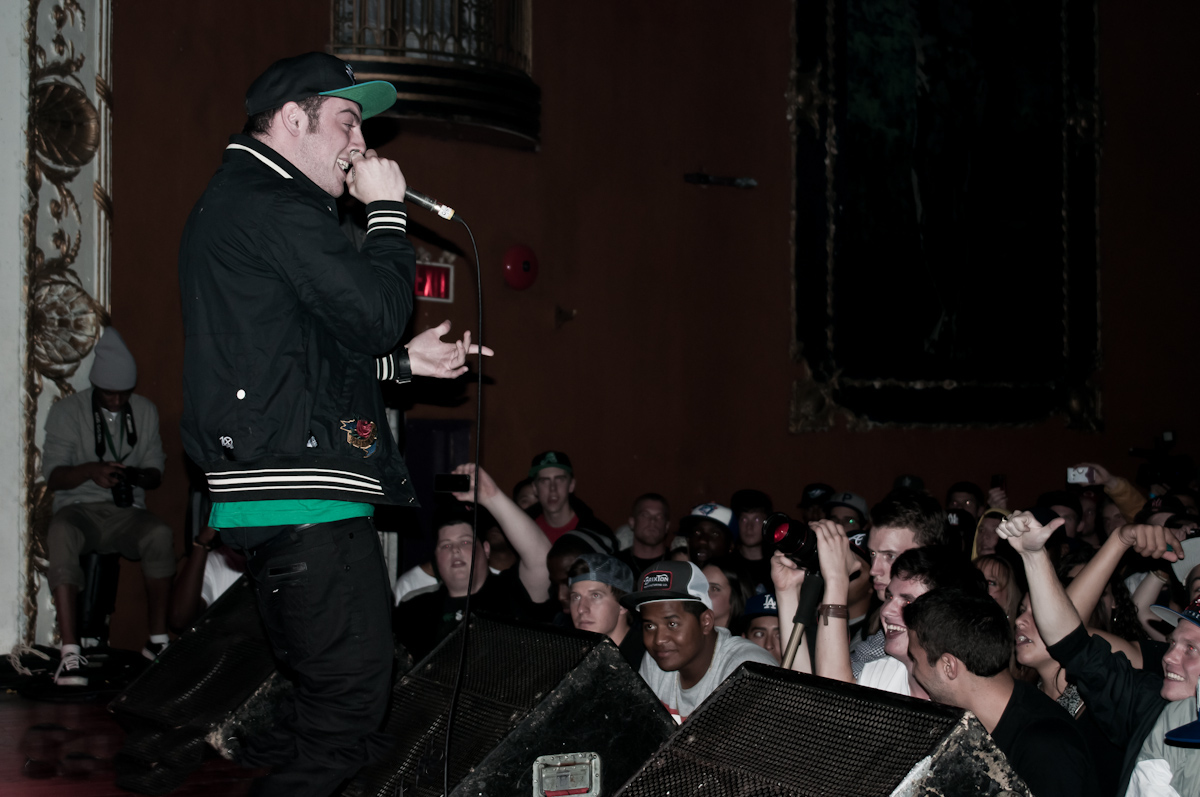
Mac Miller is one of the artists I keep coming back to when thinking about alternative hip-hop, melodic production and how a musician develops a sound over time. His work is useful to study because it does not present a single, fixed production identity. There are records built around direct, sample-led rap; projects that feel stranger and more inward-looking; soulful collaborations; and later music where live instrumentation and arrangement become a much bigger part of the picture.
That evolution is more instructive than trying to recreate a famous beat. It shows how an artist can keep a recognisable voice while changing the musical language around it — and how those decisions can make a body of work feel like a journey rather than a sequence of disconnected releases.
The shift: from a recognisable rap sound to a wider musical world
Blue Slide Park introduced a bright, energetic version of Mac Miller to a very large audience. It was direct, full of personality and rooted in the independent hip-hop momentum that had built around him. What followed was not a simple abandonment of that sound. Watching Movies with the Sound Off opened the door to more psychedelic, introspective and left-field production choices. The music began to feel less interested in fitting a familiar template and more interested in exploring what a track could become.
That curiosity continued through GO:OD AM and The Divine Feminine, which move through different balances of rap, melody, soul and collaboration. By the time of Swimming, the arrangements often feel spacious and patient. The songs have room to develop, and instrumental parts are not just decorations around a vocal — they help carry the emotion of the record.
Circles, released after his death, sits in a different and particularly delicate place in the catalogue. It should not be treated as a production template to copy. It is better approached as a companion piece that makes the direction of his late songwriting and musical interests easier to hear.
For independent artists, this matters because a first release can become a trap. Once listeners associate a project with one sound, it is tempting to keep repeating it. Mac’s catalogue is a reminder that the artist can be the connecting thread while the arrangement, instrumentation and even the genre emphasis move around.
Listen to the arrangement, not just the beat
One practical way to study these records is to listen in layers. First, follow the vocal and the lyric. Then listen again for the bass movement. On a third pass, ignore the lead vocal and pay attention to the small details around it: background harmony, guitar voicings, keyboard texture, percussion, the space between drum hits and the way the track changes as it moves towards the final section.
That kind of listening often reveals that the hook is not the only memorable part of a production. A guitar might only appear for a few bars, but it changes the emotional temperature. A bass line can move independently of the kick, giving the groove a sense of life. A chord extension or a background vocal can create tension without making the mix busier.
These are arrangement decisions before they are plug-in decisions. Compression, saturation and reverb can help a part sit in the track, but they cannot decide what the song needs. A useful exercise is to mute each element in turn and ask: does the arrangement lose something meaningful, or is this layer only filling space?
A performance that makes the musicianship visible
Mac Miller’s Swimming-era NPR Tiny Desk performance is a particularly good study reference because it puts the songs in a room with musicians. The set includes “Small Worlds”, “What’s the Use?” with Thundercat and “2009”. The presence of bass, guitar, keys, drums and strings makes the arrangement choices easier to follow than they might be in a dense studio mix.
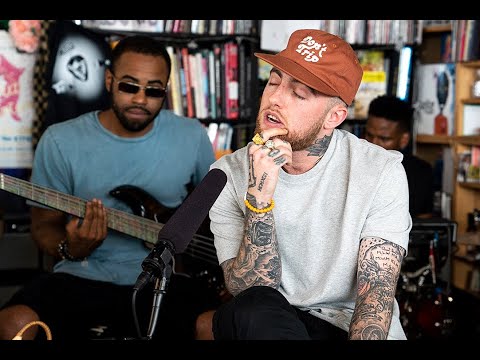
“What’s the Use?” is a useful example of a bass part doing more than marking the root note. Thundercat’s performance is a feature of the live arrangement, while the wider band gives the song a physical groove. The lesson for a producer is not to add a live bass player just because it sounds good here. It is to ask what kind of movement, timing and character a performed part can bring that a programmed line might not.
The Tiny Desk also demonstrates why a good song should survive a change of setting. When a track works with a small ensemble in a room, you can hear which elements are essential and which are production choices. That is a useful test for any arrangement, even if the final recording is entirely electronic.
Bringing those ideas into a Burnt House session
At Burnt House, the practical version of this lesson is to combine programmed production with instruments when the song calls for it. The studio has a range of instruments, monitoring and recording equipment that can support that process: the Fender Rhodes and Telecaster, Moog Sub 37, Prophet-6, Roland Fantom, UAD recording system and Focal Trio 11 monitors are all tools for making decisions, not a checklist that every track needs to use.
A Rhodes part can soften a harmony or introduce a loose, human feel. A guitar can bring a little movement or a counter-melody. A synth bass can be tightly controlled, while a performed bass line can push and pull against the drums. The key is to record with an arrangement in mind: leave room for the vocal, make each instrument’s role clear and avoid adding a layer just because the session has another track available.
Our music production and sound design page explains the wider studio approach. If you are interested in making original music collaboratively, the Make Music Together page outlines how Burnt House works with artists.
Try this: a four-pass production study
- Pass one — the song: build a simple drum and bass foundation, then write a vocal or lead part that gives the track its identity.
- Pass two — harmony: add one instrument that changes the emotional colour. Keep the arrangement sparse enough to hear the part clearly.
- Pass three — movement: add a live or performed element that brings phrasing or human timing. Try a Rhodes chord, guitar response or bass movement.
- Pass four — subtraction: mute every layer that does not improve the song. Compare the stripped version with the full arrangement at matched loudness.
The point is not to imitate a Mac Miller record. It is to practise arranging with intention and giving the performance space to breathe.
The Artist Journey — including the “MAC” documentary
I’ve also put together a YouTube playlist called The Artist Journey. It includes a documentary called MAC, which is worth watching alongside the music if you want to understand more of the artist’s story and creative path. The playlist sits here on the Burnt House page so you can watch without having to leave to search for it.
Explore the music and the wider story
↗ Mac Miller official websiteDiscography, videos, photography and archive material.
🎛 Inside Burnt House StudioSee the instruments, interfaces, monitoring and outboard used in our sessions.
♫ BRNT.WAV playlistsExplore alternative hip-hop, R&B, electronic and instrumental listening.
Mac Miller’s influence is not a recipe. It is an invitation to stay curious, to collaborate, to try a different instrument and to let the song tell you what it needs. That is a useful idea for any independent artist who wants a catalogue to develop rather than stand still.
- NPR Music — Mac Miller: Tiny Desk Concert (6 August 2018).
- Mac Miller official YouTube channel.
- Mac Miller official website and discography.
Burnt House editorial note: this is a production/listening feature, not an official biography or an endorsement by Mac Miller’s estate or collaborators. The live photograph is credited in its caption.