
BURNT HOUSE / SOUND DESIGN / LOW END
A great 808 does more than produce low frequencies. It creates movement, attitude and weight. It can act as the bass line, reinforce the kick or become the main hook. But a loud sub tone is not automatically a good 808. The sound needs to fit the key, rhythm, arrangement and playback system.
Start with the fundamental
Many 808 sounds begin with a sine-like low-frequency tone and a pitch envelope that creates the initial knock. The fundamental gives the sound weight, while harmonics help it remain audible on smaller speakers. Tune the sample to the track and check the notes across the bass line, especially when the 808 contains a long pitch drop.
Shape the envelope
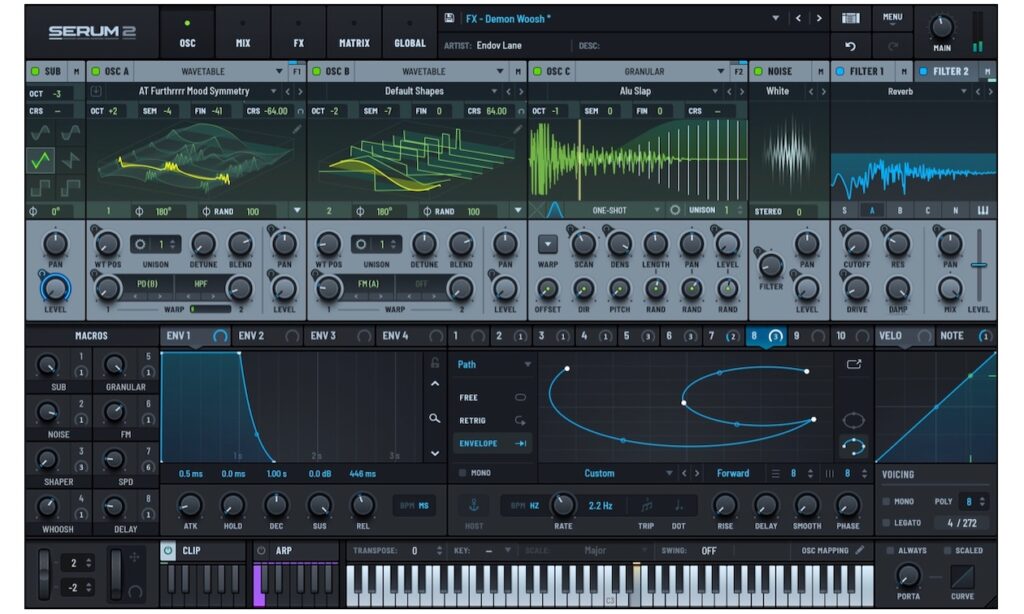
Attack, decay, sustain and release determine how the 808 behaves. A short decay can create a punchy hit; a long sustain can carry a bass note through the bar. Release time matters when notes overlap. If the tail runs into the next note, the low end can become muddy or produce unwanted pitch interactions.
Use distortion to create audibility
Harmonic saturation can help an 808 translate on headphones, laptops and small speakers where the fundamental is difficult to reproduce. Add distortion gradually and compare the processed sound at matched loudness. Too much high-frequency content can make the bass harsh, while too much low-frequency energy can consume headroom without adding perceived impact.
Make room for the kick
Decide whether the kick and 808 are meant to strike together or answer one another. If both have strong energy at the same time, the result may lose definition. Adjust timing, envelope, tuning or level before reaching for heavy sidechain processing. The best solution depends on the groove.
Check in context and across systems
Soloing can help identify distortion or clicks, but the final judgement must happen in the arrangement. Listen quietly and check whether the bass line remains clear. Test on more than one playback system and watch the master level. A sound that feels huge on headphones may disappear on small speakers if it has no useful harmonics.
Further reading
Continue with our mixing groups and buses guide and ear training for producers.
Design the pitch movement
The opening pitch drop is part of an 808’s identity. A fast drop can create a sharp knock; a slower curve can sound more vocal or dramatic. Keep the initial movement consistent enough that repeated notes feel related, but vary it when the arrangement calls for a different accent. Check the pitch at the point where the sustained note settles, not only the initial transient.
Choose note lengths to control the low end
Long MIDI notes can cause overlapping tails, especially when the sample has a slow release. Shorten notes where the groove needs separation and leave longer sustains for moments where the bass should carry the harmony. If the instrument uses glide or portamento, check how overlapping notes trigger the transition and whether the pitch arrives at the intended time.
Use harmonics without sacrificing the sub
Parallel distortion or saturation can add audible upper harmonics while preserving a cleaner low-frequency foundation. Filter the parallel layer so it contributes character rather than duplicating unnecessary sub energy. Compare the combined signal at matched loudness and check mono compatibility. If the distorted layer makes the bass sound smaller or less stable, reduce it or change the processing.
Make the kick and bass relationship intentional
Decide which element leads the groove. A short kick can provide the transient while the 808 carries the sustained note; in another arrangement, the kick may be the main low-end event and the 808 can answer in the gaps. Adjust note placement, envelopes and levels before applying sidechain compression. Check the relationship at low playback volume, where timing and definition are often easier to judge than sheer level.
Check translation and headroom
Listen on monitors, headphones and a small speaker, but do not expect every system to reproduce deep sub frequencies. The harmonics should communicate the bass line when the fundamental is absent. Check the master for excessive peaks and avoid judging loudness from a single playback system. A controlled 808 that supports the song will usually translate better than one that simply dominates the meter.