BURNT HOUSE / SOUND DESIGN / BASS & 808
A good 808 is not just a sine wave turned up. It is a controlled low-frequency instrument with a clear pitch, a useful envelope and enough harmonic information to remain audible on smaller speakers.
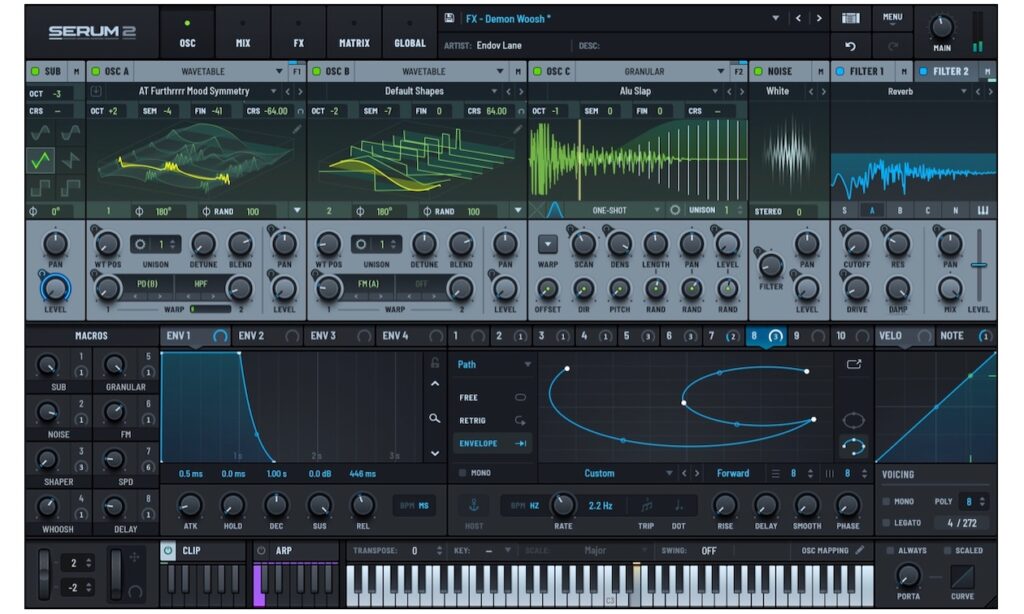
Start with the fundamental: a clean low sine
In Serum 2, begin with a simple sine or triangle-based oscillator and remove unnecessary unison or stereo widening. The lowest layer should be stable, centred and tuned to the musical note. Use a short pitch envelope only if the sound needs a defined initial drop. The pitch movement should settle quickly; too much glide or pitch bend can make the bass feel out of tune.
Set the amp envelope so the note has the right decay or sustain for the track. A long 808 may need a controlled release and careful note lengths. A short, punchy 808 may need a faster decay and little or no sustain. There is no one correct envelope for every genre.

Build the character above the sub
A pure sine can vanish on phone speakers and small laptops. Add a second oscillator or a resampled layer that generates upper harmonics. Try a triangle, a restrained saw or a sample-derived tone, then shape it with distortion, filtering and envelope movement. Keep the upper layer at a level that makes the bass audible without replacing the low-frequency foundation.
Distortion: make the harmonics work for the mix
Use saturation or distortion to create harmonics that translate on smaller playback systems. Start with a gentle amount, compare the level-matched result and increase only until the bass gains presence. If the distortion removes the note’s pitch identity, the effect is too aggressive or the source needs a cleaner foundation.
A useful method is parallel processing: keep the sub clean and distort a duplicate or separate midrange layer. This gives you control over low-end weight and aggression independently. High-pass the distorted layer so it does not create uncontrolled sub energy, and low-pass or shape the sub path to keep the fundamental focused.
Pitch envelopes and slides
Classic 808 character often comes from the initial pitch drop, not only the waveform. Try a fast downward envelope for a punchy attack, then a longer glide between selected MIDI notes. Use glide deliberately: if every note slides, the pattern can lose its rhythmic clarity. In Serum 2, tune the envelope amount and time until the opening pitch gesture is audible but not cartoonish unless that is the intended style.
Layering and phase: do not let the kick and bass cancel
When a kick and 808 hit together, compare their waveforms and listen in mono. Two low-frequency sounds can partially cancel, making the combined result weaker even when each one sounds powerful alone. You can adjust the timing, polarity, pitch, envelope or sample choice. Do not assume that a phase invert button is a universal fix: listen to the result with the entire groove playing.
Arrange the 808 like a musical part
Leave rests. Use note length, octave movement and small rhythmic changes to create a bass line that supports the track. A busy 808 can compete with the kick, vocal and main synth. A simple pattern with the right timing often feels bigger than a constant stream of notes.
A dark 808 recipe to try
- Oscillator A: clean sine, mono, no unnecessary stereo processing.
- Envelope 1: fast attack, controlled decay and release suited to the MIDI note lengths.
- Envelope 2: short downward pitch movement for the initial knock.
- Oscillator B: triangle or saw-based tone for harmonics, filtered to keep it above the sub region.
- Use a distortion stage on the upper layer; compare soft clipping, tube-style saturation and a more aggressive fold or wave-shape.
- Check the result with the kick, vocal and main synth, then test on headphones and a small speaker.
Use this as a starting point, not a preset recipe. The right 808 is the one that supports the song’s key, rhythm and arrangement.